
Welcome
Durable Tactile Sensing for Robotic Fingers
Optical tactile sensors designed for durability, maintainability, and practical use in robotic systems.
Optical tactile sensors designed for durability, maintainability, and practical use in robotic systems.
Tactile Sensors for Robotic Hands
Research of compact optical tactile sensors for humanoid robotic fingers, with emphasis on durability, tactile image quality, graceful failure, and simple field replacement.
A standard USB connection provides live tactile imaging on a computer. This demonstration shows the sensor connected to a Mac and displaying the tactile camera output in real time.
This demonstration shows real-time tactile imaging with the larger robotic finger. Surface features and contact patterns are captured optically as objects are pressed against and moved across the compliant sensing surface.
similar tactile imaging capability has been incorporated into a substantially smaller, humanoid-scale finger
The tactile sensor cartridge is designed for rapid removal and replacement without tools, wiring changes, or disassembly of the robotic finger. The demonstration also shows the internal LED illumination used for optical tactile imaging.
Tactile images obtained from several independently fabricated sensors demonstrate the imaging capability of the optical tactile finger design across multiple sensor cartridges.
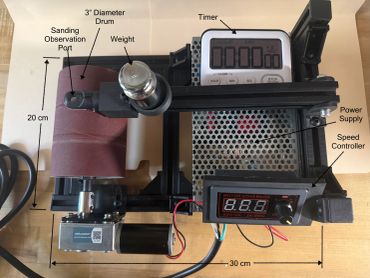
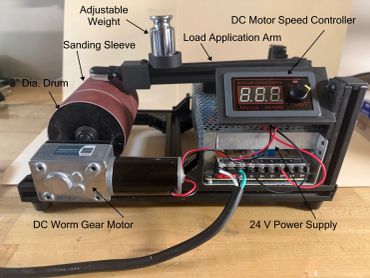
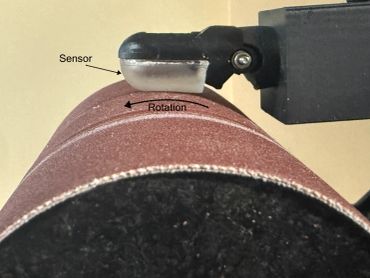
Resistance to abrasive surface damage was evaluated using a rotating-drum sanding apparatus. The sensor is held against abrasive paper mounted on a controlled-speed drum while the applied load and elapsed time are recorded. The apparatus provides an accelerated comparative measure of protective-film durability.
The representative components used to construct the apparatus are listed below. Equivalent components may be substituted where appropriate.
• Bringsmart 24 V, 80 rpm DC worm-gear motor
• POWERTEC three-inch oscillating-sander rubber drum
• Digital scale
• Dark Stone sanding sleeves
• Lam(MS)pen 24 V, 10 A switching power supply
• Qinhan sanding-drum mandrel
• Bokwin 8 mm-to-10 mm shaft coupling
• ZK-BMG DC motor speed controller
• 2020 aluminum T-slot framing, corner brackets, end caps and rubber feet
• Vovioir digital kitchen timer
• Sensor-mounting fixture
• Load-application arm bracket
• Speed-controller mounting bracket
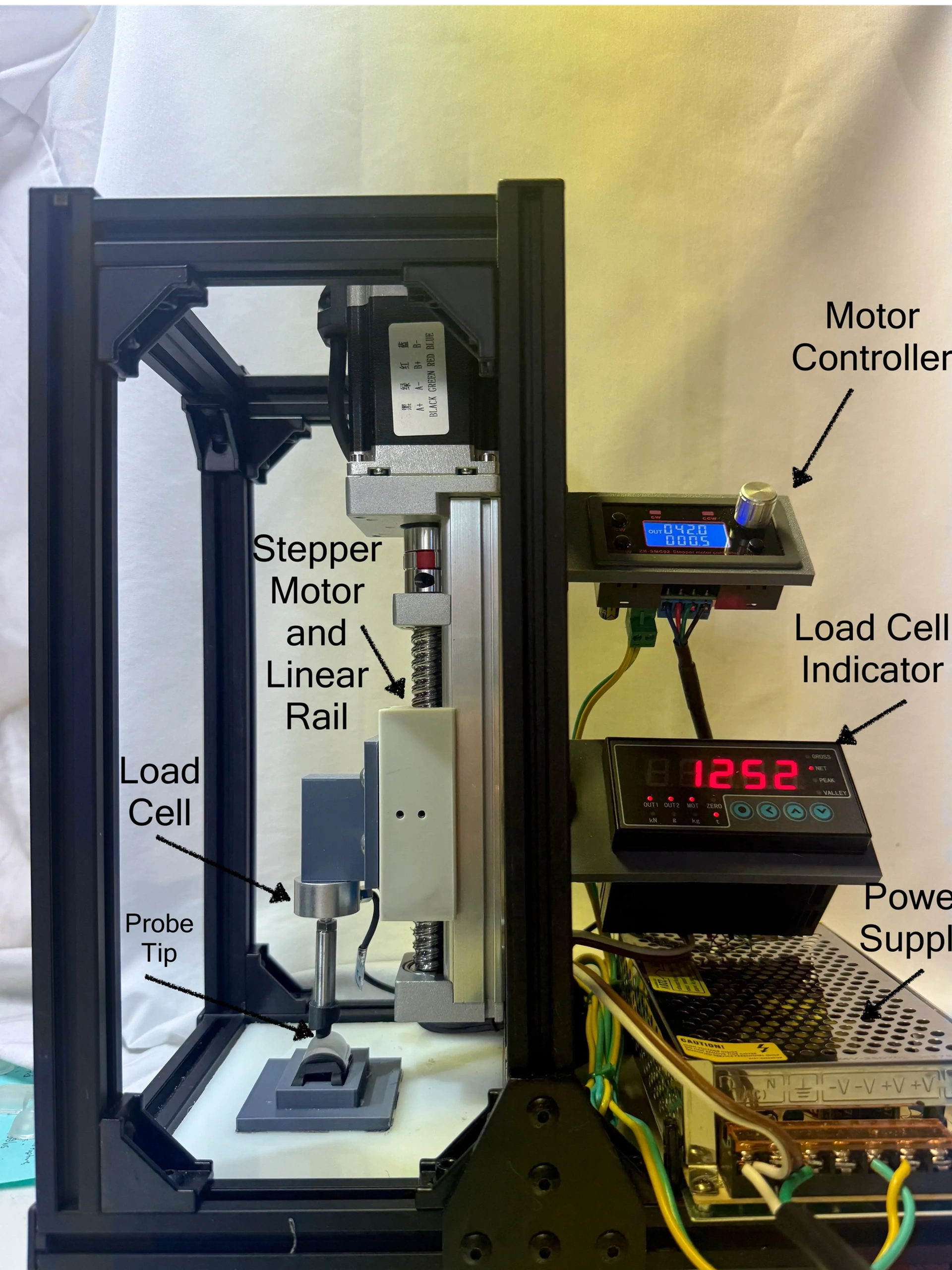
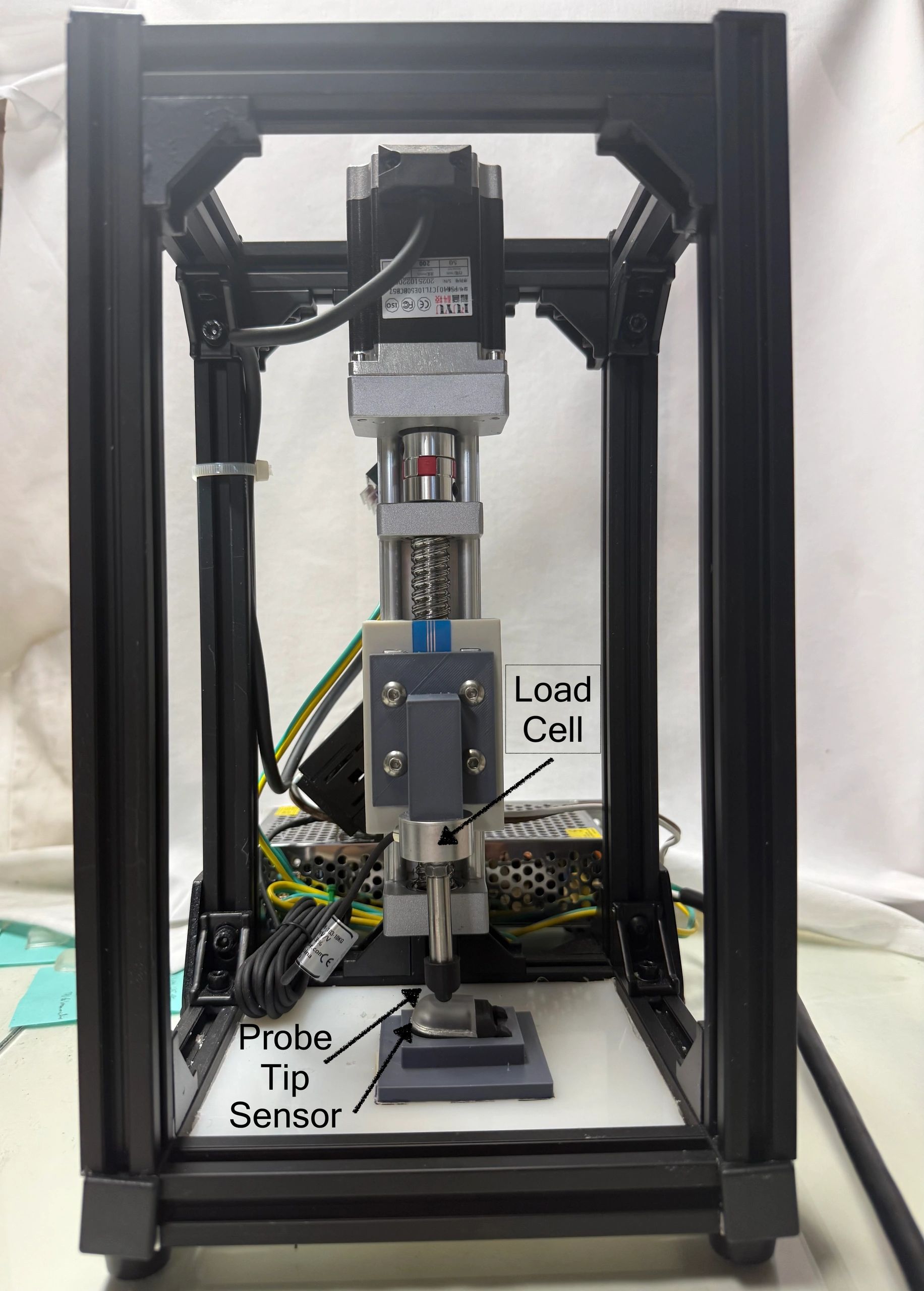
The video shows the probe repeatedly applying a controlled 39.2 N (4.0 kgf) load to the sensing surface.
Resistance to repeated concentrated loading was evaluated using a repetitive probe test (RPT). A motor-driven probe repeatedly contacts the tactile surface under controlled force and timing. Changes in surface appearance, tactile imaging, and interfacial adhesion are monitored throughout the test.
The sensors are inspected for probe imprinting, ring formation, TPU blistering, delamination at the silicone–TPU or silicone–cartridge interfaces, TPU rupture, and silicone-gel rupture.
The design, fabrication, tactile performance, and durability testing of these sensors are described in our recently published technical paper. Accelerated abrasion and repetitive loading tests demonstrate substantially improved durability, gradual rather than catastrophic degradation, and rapid sensor replacement for maintainable robotic tactile sensing.

About Richard
Education:
1965-1968 Sc.D. Chemical Engineering, Massachusetts Institute of Technology, Cambridge, Massachusetts
1962-1965 B.S.Ch.E., Chemical Engineering, University of Massachusetts, Amherst, Massachusetts
We use cookies to analyze website traffic and optimize your website experience. By accepting our use of cookies, your data will be aggregated with all other user data.